
When living near a park or a property that hosts peacocks, the first night is often a surprise. The peacock’s cry, powerful and hoarse, penetrates walls and wakes people up from dozens of meters away. This sound, sometimes compared to a human distress call, has a precise biological explanation. Understanding why the peacock cries at night allows for better coexistence with this ornamental bird with its spectacular plumage.
The three types of male peacock calls and their role
The peacock’s cry is often reduced to a single shrill sound. In reality, the male uses several distinct vocalizations, each linked to a specific context of reproduction or defense.
The “hoot” is a low call, emitted at short range. It attracts the female regardless of the male’s posture, meaning that the tail does not need to be fanned out for this call to be effective. The “keow,” higher and more recognizable, is made when the male is not displaying. Finally, the “ka” accompanies the display: the male has his train raised and keeps his distance from the female.
The most disturbing at night is what is called the “solo hoot,” a cry emitted in the complete absence of a female. The male makes this call to signal his position and attract potential mates to his display territory (the lek). It is a long-range signal, designed to cover several hundred meters, which explains its volume.
Understanding why the peacock cries at night requires taking into account this long-distance calling function, active even when the bird seems alone.

Nocturnal calls of the peacock: breeding season and triggers
The peacock does not cry with the same intensity all year round. The breeding season concentrates the majority of the noise disturbances. During this period, males become particularly vocal, especially at dusk and late at night.
Why at night rather than during the day
Night offers favorable acoustic conditions. Ambient noise (traffic, wind, human activity) decreases, and sound travels further. For a bird whose strategy relies on long-distance calling, vocalizing at night maximizes the chances of being heard by a distant female.
It is also observed that peacocks react to sudden noises in the dark. A passing vehicle, an animal moving in the underbrush, a light turning on: all these stimuli trigger an alarm call. The peacock remains a ground-dwelling animal, vulnerable to nocturnal predators, and its vocalization also serves as a vigilance signal for the group.
Frequency and duration according to the season
Outside the breeding season, calls exist but remain sporadic. A noticeable increase is observed in spring and early summer. Reports on this vary by region and breeding conditions, but the trend remains constant: the sound peak coincides with the male’s hormonal peak.
Coexisting with a noisy peacock: practical constraints
News articles regularly report neighborhood conflicts caused by peacocks. A recent case in Bas-Rhin illustrates the problem: a stray peacock, with no identified owner, prevented residents from sleeping for weeks. The inhabitants described an animal that “screamed every night,” with no immediate solution found.
This type of situation raises several practical questions:
- The peacock is an ornamental animal that must be declared at the town hall, and its owner is responsible for the disturbances it generates, including noise.
- The bird must bear an identification mark, which should allow for the owner to be found in case of wandering.
- Capturing a stray peacock is not simple: the animal flies short distances, perches high, and is wary. Interventions often require specialized equipment.
When the owner is identifiable, mediation remains the most direct approach. When the animal is stray, the town hall or municipal services can intervene, sometimes by setting a capture trap.
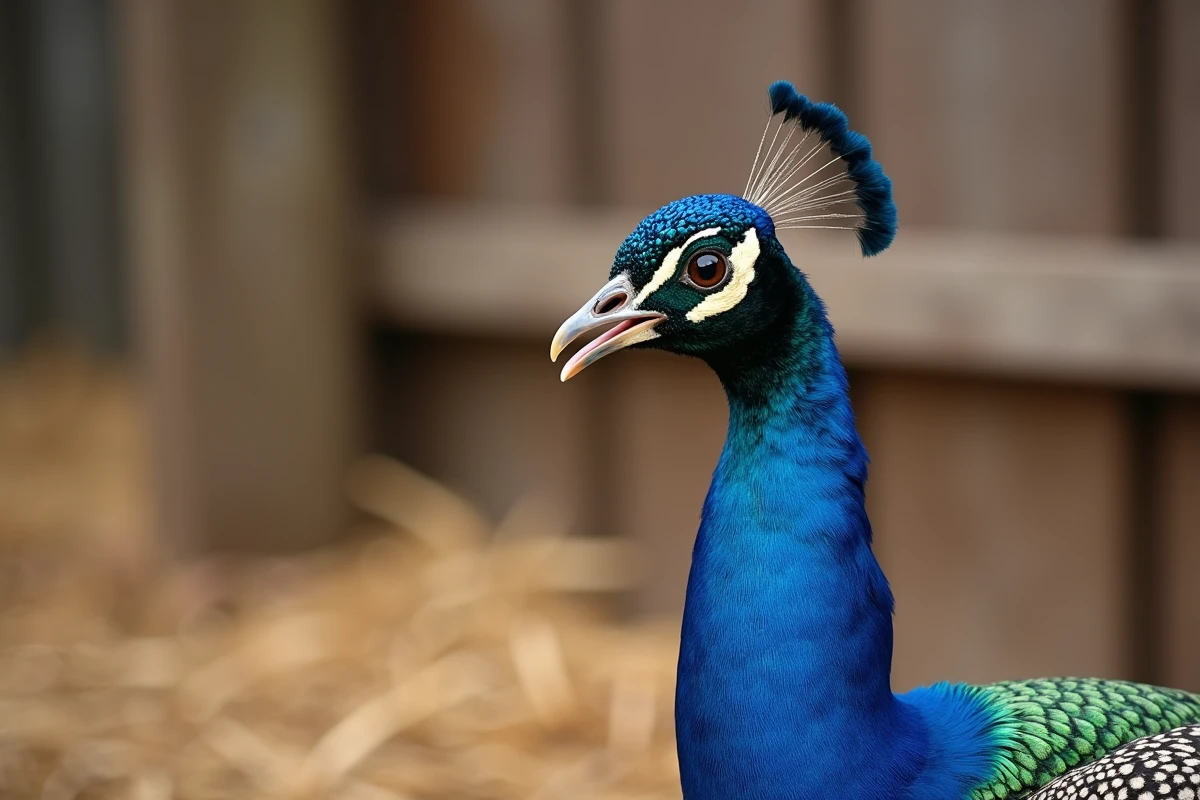
Plumage, display, and call: a complete seduction system
Reducing the peacock to its plumage or its cry would overlook the overall functioning of its reproduction. The call complements the visual display; it does not replace it. A male with damaged or too-short tail feathers will struggle to compensate with voice alone.
The male peacock’s tail, made up of long feathers adorned with ocelli (eye-shaped patterns), plays a central role in female selection. The fanned tail, combined with the quivering of the feathers and the calls, forms a multisensory ensemble. The female assesses the male’s vigor through the size of the train, the brilliance of the plumage, and the frequency of vocalizations.
Some males emit calls simulating the presence of a female or a predator to attract attention. Observations have shown that the “solo hoot” can deceive females into thinking that a male is already with a partner, making his territory more attractive. This vocal bluffing strategy increases mating chances.
Can peacock cries at night be reduced?
On the ground, peacock breeders and owners use a few approaches to limit nighttime noise. None are miraculous.
- Installing a closed shelter for the night reduces sound range and limits visual stimuli that trigger alarm calls.
- Maintaining a balanced group with enough females decreases the frequency of the male’s solitary calls.
- Avoiding artificial light sources near the perch limits the animal’s untimely awakenings.
The peacock’s cry remains a natural behavior linked to reproduction and survival. It cannot be eliminated without compromising the bird’s well-being. Coexistence involves space management and a good understanding of the animal’s seasonal cycle, anticipating the months when nights will be the noisiest.